


Hoe lang duurt het om OEM-buitenjacuzzi's te produceren?
2026-10-27 15:30We gebruiken nu 3D-modellen waarmee klanten het product kunnen bekijken, waardoor de noodzaak voor aanpassingen tijdens de productie tot een minimum wordt beperkt.
De derde fase omvat de inkoop van materialen en de voorbereiding van de productie. De fabricage van een buitenjacuzzi vereist een breed scala aan grondstoffen, zoals acrylplaten, pompen, elektronische besturingssystemen, verwarmingselementen, jets en bevestigingsmaterialen. De levertijden kunnen oplopen als de klant materialen in speciale kleuren kiest of componenten van specifieke merken vereist. Fabrikanten met een robuust supply chain management hebben daarom over het algemeen een voordeel wat betreft leveringsbetrouwbaarheid.
De vierde fase is het belangrijkste productieproces, dat het grootste deel van de totale productietijd in beslag neemt.
Eerst wordt de acrylkuip gevormd. Acrylplaten worden verwarmd tot ze zacht zijn en vervolgens door middel van vacuümvormen in de kuipwand gebracht. Strikte controle van temperatuur en vormdruk is essentieel tijdens deze fase om ongelijke wanddikte of een slechte oppervlaktekwaliteit te voorkomen.
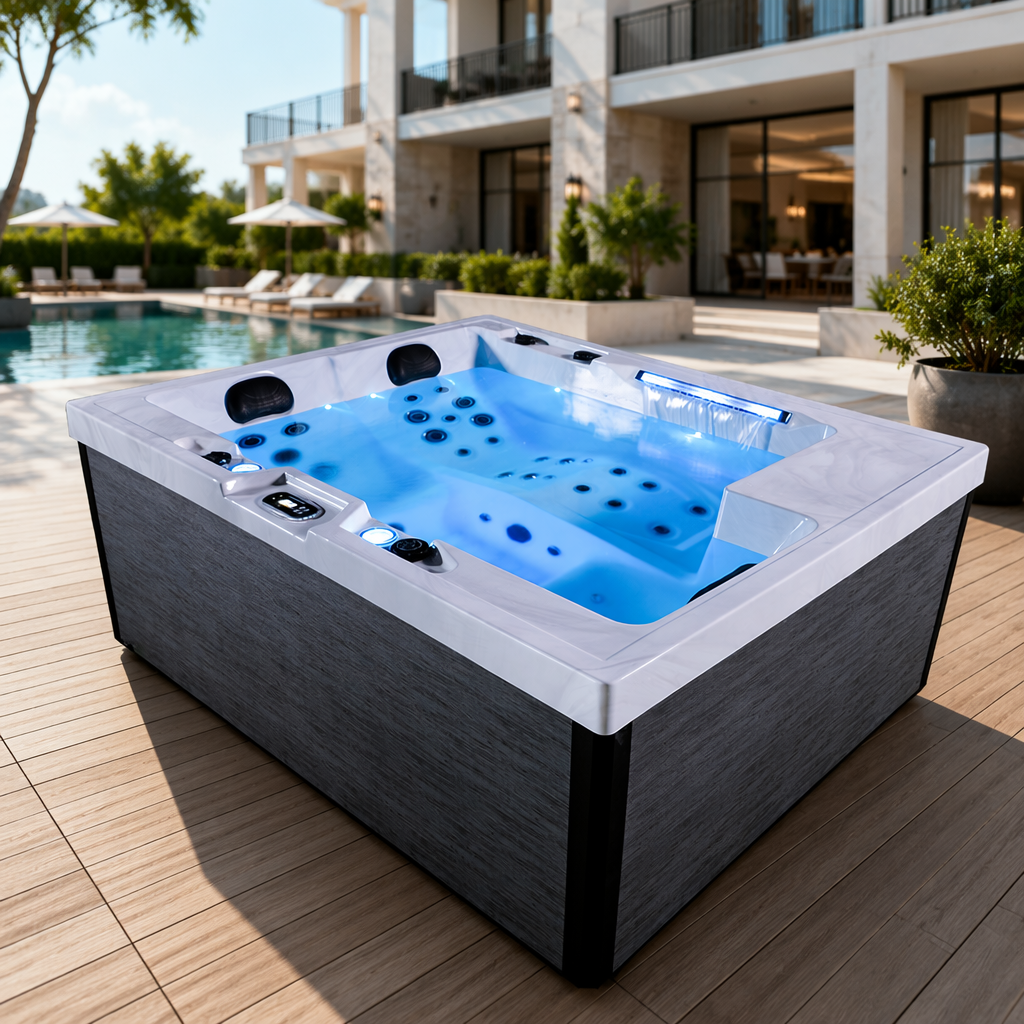
Nadat de kuip is gevormd, wordt deze versterkt met glasvezel om het draagvermogen te vergroten. Een buitenjacuzzi gevuld met water en gebruikers kan meer dan 1000 kilogram wegen, waardoor structurele integriteit cruciaal is.
Vervolgens worden de waterleidingen en elektrische systemen geïnstalleerd, inclusief de pompaansluitingen, de installatie van de jets, de installatie van de verwarming en de kalibratie van het besturingssysteem. Omdat buitenjacuzzi's zowel water als elektriciteit nodig hebben, is een veiligheidstest een onmisbare stap in het productieproces.
Ten slotte vindt de buitenmontage plaats, waarbij plinten, verlichtingssystemen en bedieningspanelen worden geïnstalleerd, gevolgd door een grondige visuele inspectie.
De vijfde fase bestaat uit kwaliteitscontrole, verpakking en verzending. Professionele fabrikanten van buitenjacuzzi's voeren doorgaans tests uit met watervulling, watercirculatie, verwarming, elektrische inspecties en visuele controles om ervoor te zorgen dat de producten aan de exportnormen voldoen.Veelgestelde vragen over OEM-productie van buitenjacuzzi's
Vraag 1: Wat is de snelste levertijd voor OEM-buitenjacuzzi's?
Als er gebruik wordt gemaakt van een bestaand, beproefd model van de fabrikant en er slechts kleine aanpassingen worden gedaan – zoals het toevoegen van een logo, het wijzigen van de verpakking of het aanpassen van eenvoudige configuraties – kan de productie doorgaans al binnen 30 dagen worden afgerond. De exacte doorlooptijd is echter afhankelijk van het ordervolume, de beschikbaarheid van materialen en de productieplanning.
Vraag 2: Waarom kunnen OEM-buitenjacuzzi's niet snel geproduceerd worden?
De productie van buitenjacuzzi's omvat meerdere fasen, waaronder de fabricage van de kuip, de installatie van het leidingwerk, de inbedrijfstelling van de elektriciteit en een uitgebreide systeemtest. Omdat veiligheid en stabiliteit van het grootste belang zijn, is de productiecyclus langer dan die van gewone producten.
Vraag 3: Kunnen OEM-fabrikanten van buitenjacuzzi's ook kleine bestellingen verwerken?
Ja. Veel fabrikanten accepteren OEM-bestellingen in kleine series, wat ideaal is voor merken die de markt willen verkennen of samples willen inkopen voor specifieke projecten. Bij grotere orderaantallen is het echter meestal nodig om de productieplanning van tevoren op te stellen.
Vraag 4: Hoe kan ik vaststellen of een fabrikant van buitenjacuzzi's betrouwbaar is?
Kopers dienen factoren zoals de productieschaal van de fabrikant, productcertificeringen, kwaliteitscontroleprocessen, exportervaring en projecthistorie te evalueren, in plaats van zich alleen te baseren op prijsopgaven.
Vraag 5: Hoe lang van tevoren moet ik contact opnemen met een OEM-fabrikant van buitenjacuzzi's?
Voor standaard OEM-projecten is het raadzaam om 2-3 maanden van tevoren te communiceren. Als het project betrekking heeft op de ontwikkeling van een nieuw product, grootschalige engineeringcontracten of merkupgrades, is het aan te raden om 3-6 maanden van tevoren te beginnen om voldoende tijd te garanderen voor productontwikkeling en -productie.
2. Standard OEM Outdoor Hot Tubs: Production cycle of approximately 45–70 days
Currently, the standard OEM model is the one adopted by the majority of overseas clients. This model encompasses not only brand customization but also adjustments to product specifications, such as:
•Changing exterior colors;
•Adjusting the number and layout of jets;
•Swapping control systems;
•Configuring for different voltage standards;
•Customizing packaging designs;
•Adding special features.
For instance, the US market typically requires compliance with local voltage and safety standards; the European market imposes stricter requirements regarding product certification and energy efficiency; and the Australian market may involve different electrical standards. Consequently, outdoor hot tub manufacturers must adjust product configurations based on the target market.
A standard OEM outdoor hot tub project typically involves 5–10 days for design confirmation, 7–15 days for engineering adjustments, 30–45 days for manufacturing, and 5–10 days for quality inspection and packaging, resulting in a total cycle of approximately 45–70 days.
For overseas brand clients, this model balances product differentiation with production efficiency, making it a common form of collaboration in the international market.
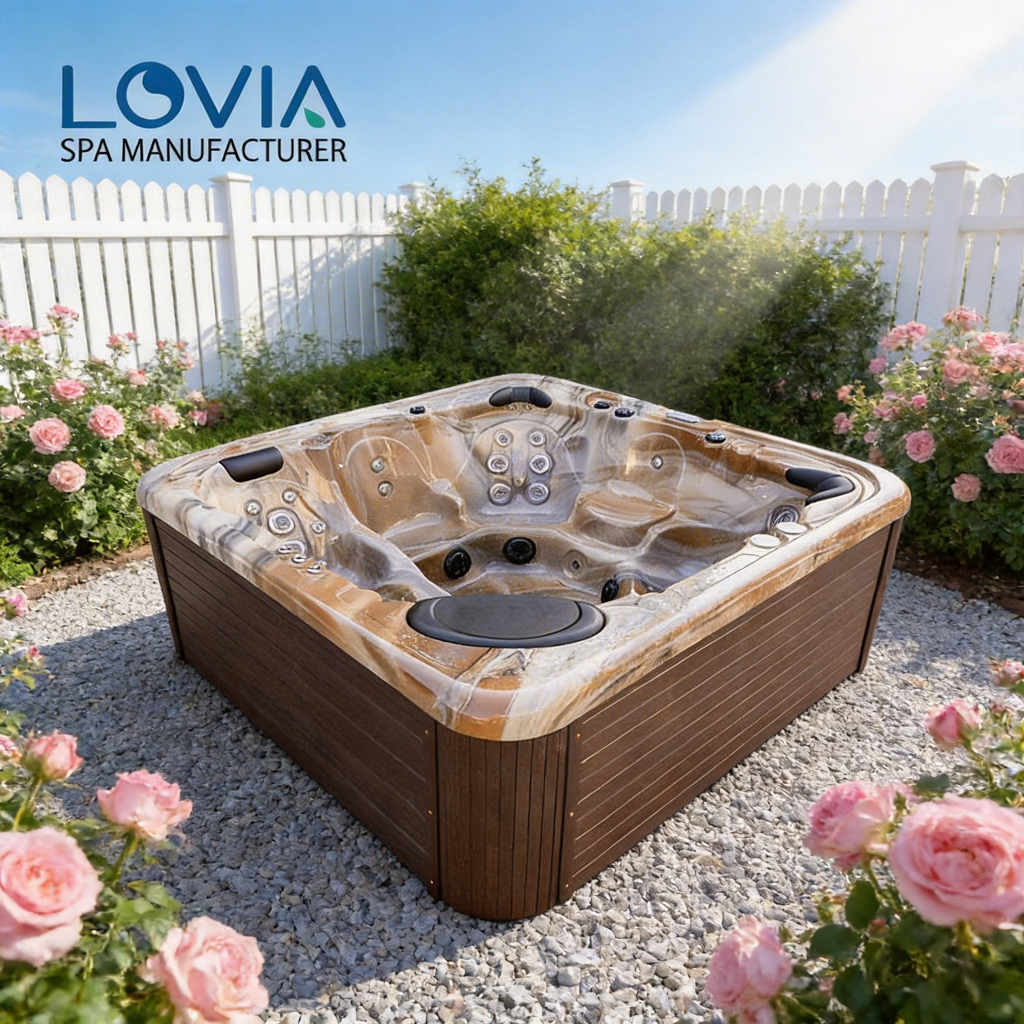
3. Deep Customization OEM/ODM Projects: Production Cycle of Approximately 60–120 Days
If a client wishes to create an outdoor spa hot tub that is entirely distinct from existing market offerings, the project enters a deep customization phase.
Examples include:
•All-new dimensional design;
•Unique shell structure;
•Development of new molds;
•Specialized jet layout;
•Development of new functional systems;
•Exclusive exterior design.
Such projects require a comprehensive development process, including product conceptualization, structural design, 3D modeling, engineering assessment, prototype fabrication, functional testing, and client approval.
Notably, developing new molds is often time-consuming, as the molding of outdoor hot tub shells requires specialized tooling. If the product structure is complex, the prototype testing phase may necessitate multiple rounds of adjustments.
Therefore, it is generally recommended to plan deep-customization OEM outdoor hot tub projects 3–6 months in advance to avoid disrupting market launch and sales schedules.
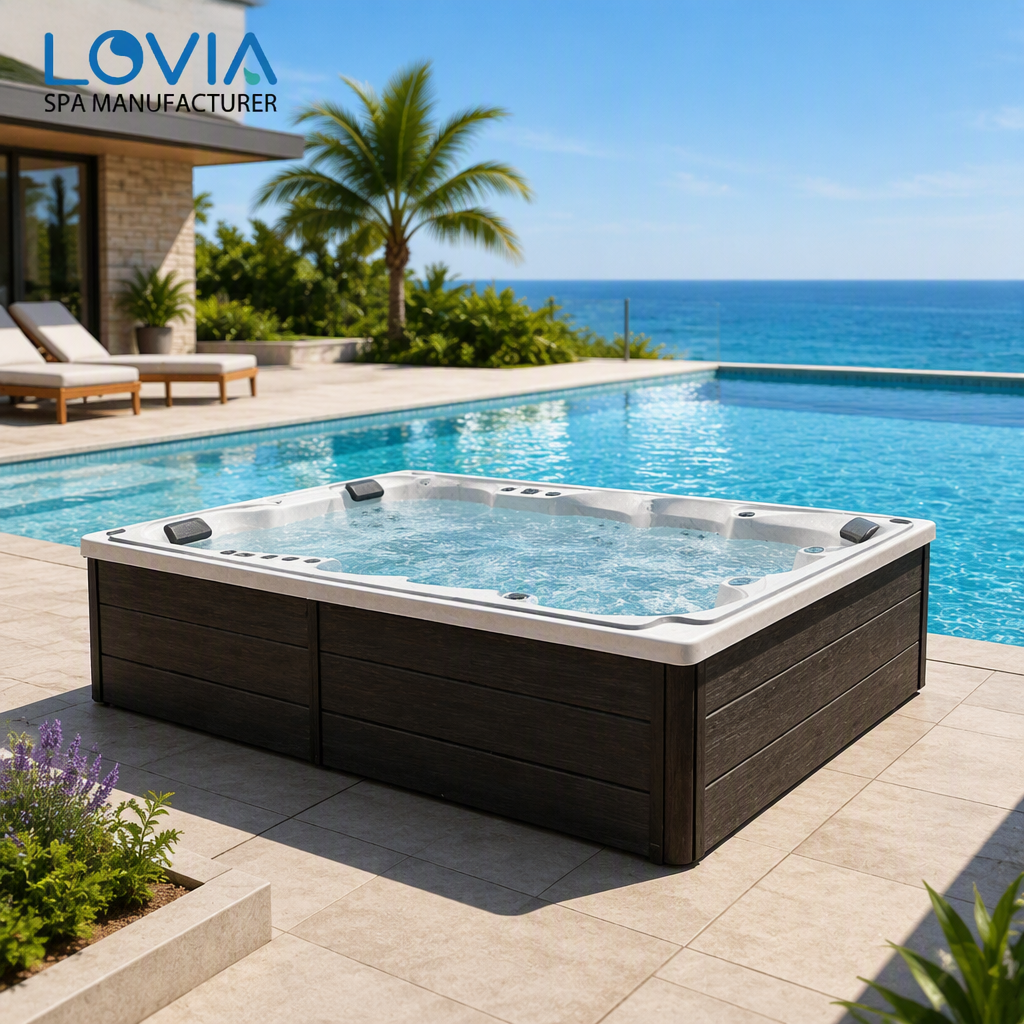
Analysis of the Complete OEM Outdoor Hot Tub Production Process and Timeline
To accurately understand the production cycle, it is essential to grasp the actual manufacturing process employed by outdoor hot tub manufacturers.
The process begins with the requirements communication phase. This is a critical stage that influences the efficiency of the entire project. Clients need to clearly communicate the intended use, target market, dimensional requirements, functional specifications, and certification standards to the manufacturer. For instance, there are significant differences in structural design, pump configuration, and durability requirements between a 4–6 person outdoor spa hot tub for residential use and large-scale spa equipment intended for hotel projects.
If requirements are unclear at the outset, frequent design modifications later on will significantly extend production time. Consequently, professional OEM suppliers typically involve their engineering teams in project assessment rather than simply providing quotes based on images.
The second stage is product design confirmation. For established models, only the appearance and configuration need to be confirmed; for custom products, CAD design, structural analysis, and functional planning must be completed. Many outdoor hot tub manufacturers now use 3D models to allow clients to preview the product, thereby minimizing the need for modifications during production.
The third stage involves material procurement and production preparation. Manufacturing an outdoor hot tub requires a wide range of raw materials, such as acrylic sheets, pumps, electronic control systems, heaters, jets, and hardware fittings. Lead times may increase if the client selects materials in special colors or specifies components from particular brands. Therefore, manufacturers with robust supply chain management capabilities generally hold an advantage regarding delivery reliability.
The fourth stage is the main manufacturing process, which accounts for the largest share of the total production time.
First, the acrylic tub shell is formed. Acrylic sheets are heated until soft and then shaped into the tub body using a vacuum forming process. Strict control of temperature and forming pressure is essential during this stage to prevent uneven wall thickness or compromised surface quality.
Once the shell is formed, it undergoes fiberglass reinforcement to enhance its load-bearing capacity. An outdoor spa hot tub filled with water and users can weigh over 1,000 kilograms, making structural integrity crucial.
Next comes the installation of plumbing and electrical systems, including pump connections, jet installation, heater setup, and control system calibration. Since outdoor hot tubs involve both water and electricity, safety testing is an indispensable step in the production process.
Finally, external assembly takes place, covering the installation of skirting panels, lighting systems, and control panels, followed by a comprehensive visual inspection.
The fifth stage consists of quality inspection, packaging, and shipping. Professional outdoor hot tub manufacturers typically conduct water-fill tests, water circulation tests, heating tests, electrical inspections, and visual checks to ensure products meet export standards.
FAQ: Common Questions About OEM Outdoor Hot Tub Production
Q1: What is the fastest delivery time for OEM outdoor hot tubs?
If using an existing, mature model from the manufacturer and making only minor adjustments—such as adding a logo, changing packaging, or modifying simple configurations—production can usually be completed in as little as 30 days. However, the exact timeframe depends on order volume, material availability, and the production schedule.
Q2: Why can't OEM outdoor hot tubs be produced quickly?
Outdoor hot tubs involve multiple stages—including shell manufacturing, plumbing installation, electrical commissioning, and comprehensive system testing. Because safety and stability are paramount, the production cycle is longer than that of ordinary products.
Q3: Can OEM outdoor hot tub manufacturers accommodate small-batch orders?
Yes. Many manufacturers accept small-batch OEM orders, which are ideal for brands testing the market or sourcing samples for specific projects. However, if order volumes increase, production planning usually needs to be arranged in advance.
Q4: How can I determine if an outdoor hot tub manufacturer is reliable?
Buyers should evaluate factors such as the manufacturer's production scale, product certifications, quality control processes, export experience, and past project history, rather than simply comparing price quotes.
Q5: How far in advance should I contact an OEM outdoor hot tub manufacturer?
For standard OEM projects, it is advisable to initiate communication 2–3 months in advance. If the project involves new product development, large-scale engineering contracts, or brand upgrades, it is recommended to start 3–6 months ahead of time to ensure sufficient lead time for product development and production.
fabrikanten van buitenjacuzzi's